


The global portable power station market is experiencing rapid expansion. Valued at approximately USD 5.6 billion in 2025, it is projected to reach USD 10.1 billion by 2033, growing at a compound annual growth rate (CAGR) of 7.67%. For wholesale buyers, importers, and procurement professionals, this growth presents significant opportunities—but also challenges. Selecting the right capacity for portable power stations is one of the most critical decisions you will make, directly impacting your customers' satisfaction and your bottom line.
About PurMars Power: Your Trusted Manufacturing Partner
PurMars Power is a manufacturer and supplier with in-house R&D and production capabilities. Our product portfolio spans four main series: portable energy storage systems (covering 100W to 60kW+), outdoor portable power stations, off-grid home energy storage systems, and automotive power tools including rechargeable tire inflators and 2-in-1 jump starter & tire inflator combos. We maintain a strong product design and power solution R&D team capable of meeting the needs of OEM and ODM customers.
All our power sources use the safest lithium iron phosphate (LiFePO₄) batteries. Each product undergoes rigorous quality testing with precision instruments throughout the manufacturing process and has passed test reports including UL (USA), FCC-ID (USA), CE (Europe), and PSE (Japan). We warmly welcome all partners to discuss potential collaboration.

Understand the Two Core Parameters: Capacity vs. Power
Before diving into capacity selection, it is essential to distinguish between two fundamental specifications:
Capacity (measured in Watt-hours, Wh) determines how long a power station can run your devices. A 1,024Wh unit can theoretically supply 1 watt for 1,024 hours, 512 watts for 2 hours, or 1,024 watts for 1 hour. Think of capacity as the size of your "fuel tank."
Output Power (measured in Watts, W) determines what you can run at all. Every appliance has both a startup wattage (surge power) and a running wattage. Some devices—particularly those with motors or compressors, such as refrigerators and power tools—require significantly higher startup power.
Many contractors purchase a 2,400W continuous station assuming it can run a saw and a compressor simultaneously because each individual tool is under 2,400W. They ignore surge and simultaneous load requirements, leading to repeated tripping on site—the number one reason power stations get returned in this category.
Step 1: Calculate Your Target Customers' Energy Needs
The fundamental formula for capacity selection is straightforward:
Required Capacity (Wh) = Device Wattage (W) × Usage Time (hours)
For example, a 400Wh unit can keep a 40W portable cooler running for approximately 10 hours. However, in real-world B2B procurement scenarios, you must consider multiple factors simultaneously.
Begin by listing all devices your end-users will power simultaneously. Identify both running wattage and surge wattage for each device. Multiply each device's running wattage by the expected daily usage hours to calculate daily energy consumption. Add a buffer of approximately 20% for conversion losses and unexpected needs. Finally, determine whether the storage capacity will be sufficient for the entire workday or intended usage period.
Step 2: Match Capacity to Application Scenarios
Different applications demand different capacity tiers. Understanding these segments helps you make informed sourcing decisions.
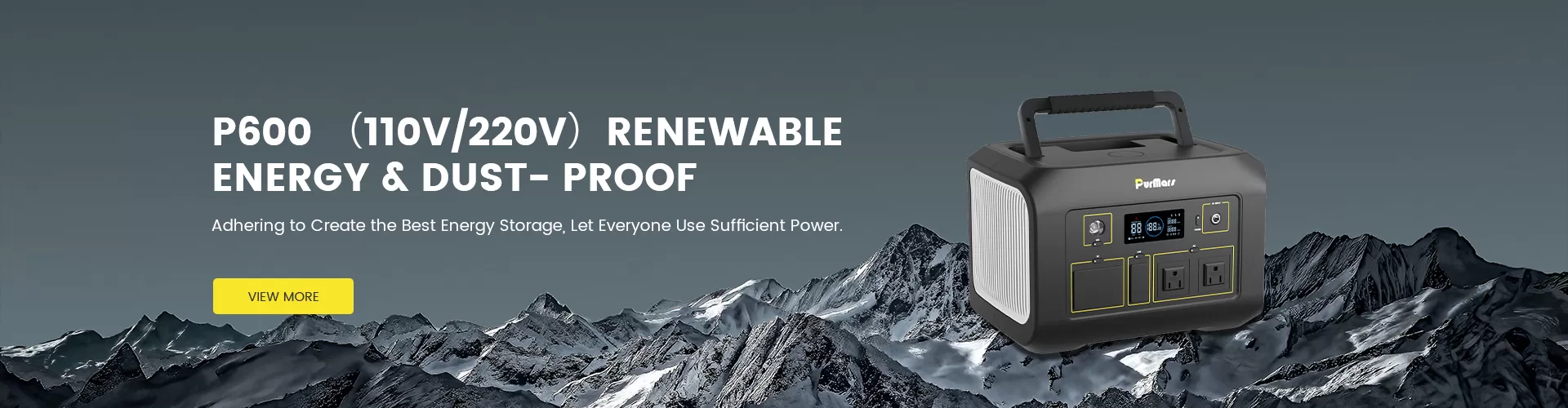
100W–600W (Compact/Personal Use): Ideal for charging smartphones, tablets, laptops, LED lights, and small fans. Suitable for weekend camping, short outdoor activities, and light emergency backup. These units are lightweight and highly portable, appealing to retail consumers and outdoor enthusiasts. Purmars offers outdoor portable power stations in 100W, 300W, 600W, 1200W, and 2400W configurations to meet diverse consumer needs.

600W–2,400W (Mid-Range/Outdoor & RV): Can power portable refrigerators, coffee makers, CPAP machines, small power tools, and multiple devices simultaneously. The 2,000-watt capacity is often sufficient for an entire workday on many job sites. This segment serves RV travelers, remote workers, and small contractors.

3kW–6kW+ (Heavy-Duty/Professional & Construction): Designed for demanding applications including 315 welding machines (supporting 3.2mm and 4.0mm electrodes for extended full-load operation), concrete mixers, high-pressure washers, and multiple heavy-duty tools simultaneously. These units typically feature industrial-grade inverters with dustproof, waterproof, and shock-resistant designs, capable of sustained full-load output even in ambient temperatures up to 50°C. This segment targets construction sites, road repair projects, medical facilities, and emergency rescue operations.

Purmars' Portable Energy Storage (PES) series for single-phase 220V applications delivers 3000W, 5000W, and 6200W configurations—with the 6200W model capable of supporting 315 welding machines with 4.0mm electrodes for extended full-load operation, as well as external frequency converters. For three-phase 380V applications, our PES series offers 6kW, 18kW, 30kW, and 60kW models supporting 220/380V, photovoltaic, and DC charging, diesel-storage parallel operation, and peak shaving through multiple-unit parallel connection.
6kW–60kW+ (Industrial/Three-Phase Applications): Support 220V/380V, photovoltaic, and DC charging, diesel-storage parallel operation, and peak shaving through multiple unit parallel connection. Designed for large-scale construction projects, industrial applications, and critical infrastructure backup.

Step 3: Evaluate Critical Technical Specifications
Beyond capacity, several technical factors significantly impact product performance and market competitiveness.
Battery Chemistry: All power sources should utilize lithium iron phosphate (LiFePO₄) batteries, which offer superior safety, longer cycle life (typically 3,000+ cycles), and better thermal stability compared to traditional lithium-ion alternatives. Purmars devices incorporate semi-solid state LiFePO₄ battery cells (25.6V, 8-series, 280Ah) that meet puncture-level safety testing, with a rated capacity of 7168Wh—delivering high safety and high energy density.
Safety Certifications: Ensure products have passed rigorous testing and obtained relevant certifications for your target markets, including UL (USA), FCC-ID (USA), CE (Europe), and PSE (Japan). These certifications are non-negotiable for professional procurement.
Inverter Quality: Pure sine wave inverters are essential for sensitive electronics and many professional tools. Engineering-grade inverters with dustproof, waterproof, and shock-resistant designs ensure reliability in demanding environments.
BMS Protection: A comprehensive Battery Management System should provide overcharge, over-discharge, overcurrent, short circuit, overtemperature, and reverse connection protection.
OEM/ODM Considerations for Volume Buyers
For wholesale buyers seeking competitive advantage, OEM and ODM customization capabilities are crucial. When evaluating potential manufacturing partners, consider factory size and workforce capacity as key indicators of scalability. Look for suppliers with in-house R&D teams capable of meeting specific power solution requirements, flexible customization options including power, capacity, and interface configurations, and proven experience across diverse applications from outdoor recreation to industrial construction.
Purmars offers comprehensive OEM/ODM services across all product lines—portable energy storage, outdoor power stations, home off-grid energy storage (5kW, 10kW, 15kW, 20kW, 30kW configurations), and automotive power tools. Our in-house R&D team can tailor power ratings, capacities, interfaces, and even physical designs to meet your specific market requirements.

Conclusion
Selecting the right portable power station capacity requires a systematic approach: understanding the distinction between capacity and power, calculating actual energy needs based on real-world applications, matching capacity to target market segments, and evaluating critical technical specifications including battery chemistry, safety certifications, and inverter quality.
As the portable power station market continues its robust growth trajectory, informed sourcing decisions will differentiate successful distributors from the competition. By partnering with manufacturers that offer comprehensive product ranges, rigorous quality control, and flexible customization options—like Purmars Power—you can build a competitive portfolio that meets diverse customer needs across consumer, commercial, and industrial applications.
Ready to discuss your specific sourcing requirements? Contact Purmars Power today to explore how our OEM/ODM capabilities and comprehensive product range can support your business growth.


